
One of the most common questions we get at Ashario Pets is:
“How much raw food should I feed my dog?”
Raw diets can be a great way to support your dog’s health, but portion control is key. This simple guide will help you understand how much to feed based on your dog’s weight and activity level.
Raw Feeding Guidelines
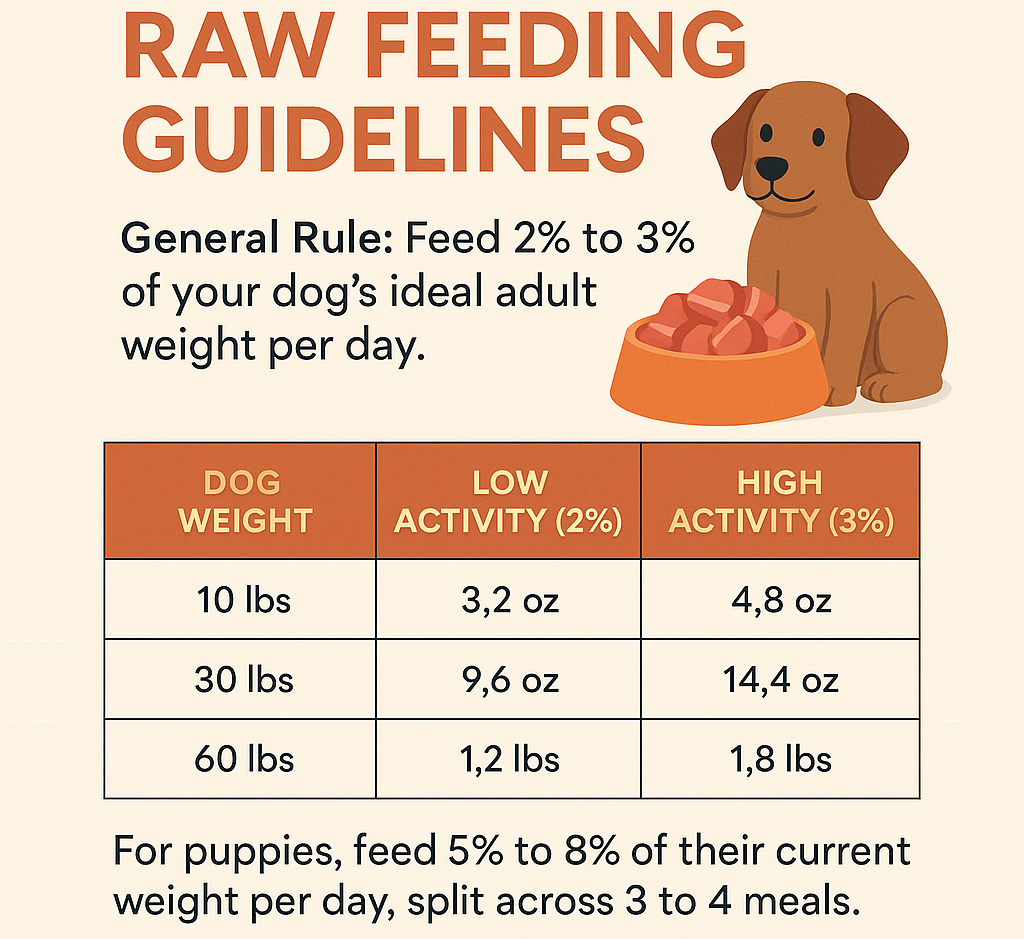
General Rule: Feed 2% to 3% of your dog’s ideal adult weight per day.
| Dog Weight | Low Activity (2%) | High Activity (3%) |
|---|---|---|
| 10 lbs | 3.2 oz | 4.8 oz |
| 30 lbs | 9.6 oz | 14.4 oz |
| 60 lbs | 1.2 lbs | 1.8 lbs |
For puppies, feed 5% to 8% of their current weight per day, split across 3 to 4 meals.
Raw Dog Food Brands We Carry
At Ashario Pets, we offer a variety of trusted raw food options including:
Tips for Transitioning to Raw
- Start with 25% raw and 75% of your dog’s current food
- Increase the raw portion gradually over 7 to 10 days
- Begin with one protein source (chicken or turkey is best)
Final Thoughts
Feeding raw doesn’t have to be complicated. Use the guidelines above as a starting point, and adjust based on your dog’s activity and health. If you need help selecting the right product, our team is here to help — in-store or online.
We also offer same-day delivery across the GTA for all in-stock raw food orders.
Contact Information
- Address: 1111A Finch Ave West, Unit 2
- Phone: 647-564-4433
- Website: https://ashariopets.ca/
- Email: info@ashariopets.ca
- Instagram: @ashariopets
- TikTok: @ashariopets
How to Adjust Raw Portions by Life Stage and Body Condition
The 2–3% guideline is a reliable starting point, but your dog's life stage and current body condition matter just as much as the number on the scale. A senior dog with a slower metabolism and lower activity level will typically do best at the lower end of the range — or even slightly below 2% — while a young adult dog in peak condition who runs, hikes, or works may need closer to 3.5%. The key is to use the guideline to set your starting portion, then assess your dog's body condition every two weeks: you should be able to feel the ribs easily without pressing hard, but not see them prominently. If ribs are hard to find under a layer of fat, reduce the daily portion by about 10%. If your dog looks ribby or is losing muscle tone, increase by the same amount.
Pregnant and nursing dogs have dramatically higher caloric needs. A pregnant dog approaching her final trimester may need up to 25–50% more food than her maintenance amount, and a nursing dam feeding a large litter can require two to three times her normal intake. In these cases it is especially important to work with your veterinarian to monitor body condition and ensure the diet is nutritionally complete, since raw feeding during reproduction requires careful attention to calcium-to-phosphorus ratios. Spayed and neutered dogs often have lower energy requirements than intact dogs of the same breed and age, so owners sometimes find they need to feed at the lower end of the recommended range to maintain a healthy weight.
Dogs recovering from illness or surgery may temporarily need easily digestible proteins like chicken or turkey in slightly smaller, more frequent meals. Conversely, highly active working breeds — sled dogs, sport dogs, herding breeds in full work — can sometimes exceed the standard 3% guideline entirely. If you are unsure where your dog falls on the spectrum, the team at Ashario Pets' North York location can help you assess options in-store, and many raw food brands also provide feeding calculators on their packaging to help you fine-tune portions.
Understanding Complete and Balanced Raw Diets vs. Prey-Model Feeding
Not all raw dog food is formulated the same way, and understanding the difference helps you avoid nutritional gaps. Commercially prepared complete-and-balanced raw foods are formulated to meet established canine nutritional standards set by bodies such as the Association of American Feed Control Officials (AAFCO). These products contain muscle meat, organ meat, ground bone, and often added vitamins and minerals to cover any gaps. They are the most straightforward option for owners new to raw feeding because you do not need to manually balance meals — the work has been done for you. Brands like those carried at Ashario Pets are designed so that feeding the right portion by weight is genuinely sufficient for day-to-day nutrition.
Prey-model raw (PMR) feeding, on the other hand, is a do-it-yourself approach where owners source and combine whole muscle meat, raw meaty bones, and secreting organs in approximate ratios that mimic what a dog might eat in the wild — a common target is roughly 80% muscle meat, 10% raw edible bone, and 10% organ (with about half of that being liver). While many experienced raw feeders follow this approach successfully, it requires more knowledge, careful sourcing, and ideally periodic bloodwork to confirm the dog is getting adequate nutrients like zinc, vitamin D, and iodine. For most Canadian pet owners shopping for convenience and confidence, starting with a commercially prepared raw formula removes much of the guesswork.
Some owners blend both approaches — using a commercial raw base for most meals and supplementing with whole raw meaty bones for dental enrichment or additional mental stimulation. If you are considering this hybrid route, it is worth discussing with a veterinarian who is familiar with raw nutrition to make sure you are not doubling up on certain nutrients like calcium. Ashario Pets carries a range of raw formats — from frozen patties and rolls to freeze-dried options — so you can find a style that fits your dog's needs and your household routine.
Safe Handling and Storage of Raw Dog Food in a Canadian Home
Raw meat-based diets require the same food-safety discipline you would apply to raw meat in your own kitchen. Cross-contamination is the primary concern: use a dedicated bowl, scoop, and preparation surface for your dog's raw meals, and wash everything with hot soapy water immediately after use. Raw food that has been thawed in the refrigerator should be used within two to three days; do not refreeze meat that has already been fully thawed unless it was thawed at refrigerator temperature the entire time. Leaving a raw meal out at room temperature for more than 20–30 minutes creates conditions where bacterial populations can grow quickly, so remove and discard any uneaten food promptly.
Storage is an important consideration for Canadian households, especially during warm Ontario summers when kitchen temperatures can rise. A dedicated small chest freezer is a popular investment among committed raw feeders because it allows you to buy in larger quantities — reducing trips to the store — without compromising food safety. Most commercially prepared frozen raw foods are packaged in individual patties or portions specifically to make portioning and thawing easier. Ashario Pets offers same-day delivery across the GTA, which is a practical option for topping up your supply without having to manage a large freezer inventory if space is tight.
Immunocompromised individuals, young children, and elderly family members in the household are at greater risk from exposure to bacteria that can be present in raw meat, including Salmonella and Listeria. Health Canada and most veterinary bodies recommend that households with vulnerable members weigh this risk carefully when choosing a raw diet. Thorough hand-washing after handling raw food and keeping pets off kitchen prep surfaces are simple measures that significantly reduce household exposure. Some owners in this situation opt for freeze-dried raw, which offers many of the nutritional benefits of fresh raw in a format with a greatly reduced bacterial load, while still being minimally processed compared to conventional kibble.
Rotating Proteins: Why Variety Matters and How to Do It Without Upsetting Your Dog's Stomach
One of the most widely recommended practices among experienced raw feeders is protein rotation — feeding different animal proteins across weeks or months rather than sticking to a single source like chicken indefinitely. The rationale has two main dimensions. First, different proteins bring slightly different micronutrient and amino acid profiles, so rotating across chicken, turkey, beef, lamb, duck, rabbit, or fish can help fill any minor nutritional gaps that exist in a single-protein diet. Second, some veterinary dermatologists believe that repeated long-term exposure to a single protein may contribute to the development of a food sensitivity in predisposed dogs, though the evidence is still evolving. Rotating proteins can make it easier to identify the source if a food sensitivity does develop, since you will have experience feeding several different options.
The practical challenge with rotation is that dogs with sensitive digestive systems can experience loose stools when proteins change too abruptly. The same gradual transition approach that works for switching from kibble to raw applies here: introduce a new protein by blending a small amount into the current protein, then slowly increase the ratio over five to seven days. Most dogs become more adaptable to protein switches over time, and many seasoned raw-fed dogs can handle a new protein introduction within just a day or two. If your dog consistently reacts to new proteins with digestive upset, it is worth discussing with a veterinarian to rule out an underlying sensitivity or microbiome imbalance.
Fish-based raw foods are a particularly valuable rotation option for Canadian dogs because of their natural omega-3 fatty acid content, which supports skin, coat, and joint health — especially beneficial during dry Canadian winters when skin issues tend to flare. Ashario Pets' selection includes options across multiple protein sources, so you can build a rotation plan without having to shop multiple stores. When browsing, look for products labelled as single-protein or single-source so you can confidently attribute any reaction to a specific ingredient if needed.
Frequently Asked Questions
Can I feed my dog raw food every day, or should I mix it with kibble?
Many dogs thrive on a fully raw diet fed daily, provided the food is nutritionally complete and portioned correctly. Some owners choose to mix raw and kibble for convenience or cost reasons; if you do this, be aware that raw and kibble digest at different rates, which can occasionally cause digestive upset in sensitive dogs. Feeding them at separate meals rather than in the same bowl tends to work better for dogs with delicate stomachs.
How do I know if my dog is eating the right amount of raw food?
The most reliable indicator is your dog's body condition score rather than the scale alone. You should be able to feel your dog's ribs without pressing firmly, see a visible waist when viewed from above, and notice an abdominal tuck when viewed from the side. Weigh your dog monthly and reassess portion sizes if body condition changes. Your veterinarian can demonstrate how to assess body condition score at your next check-up.
Is freeze-dried raw food as nutritious as frozen raw?
Freeze-drying removes moisture at low temperatures, which preserves much of the nutritional profile of fresh raw meat while making the product shelf-stable and easier to store. Most veterinary nutritionists consider high-quality freeze-dried raw to be nutritionally comparable to frozen raw when rehydrated as directed. It is a practical option for travel, households with limited freezer space, or as a topper to add raw nutrition to a kibble-based diet.
Do I need to add supplements to a commercially prepared raw diet?
If you are feeding a product labelled as complete and balanced, additional supplementation is generally unnecessary and can actually cause imbalances — particularly with fat-soluble vitamins and minerals like calcium. The exception would be if your veterinarian identifies a specific deficiency through bloodwork or recommends a supplement for a diagnosed health condition. Always consult your vet before adding supplements to any diet.
Does Ashario Pets ship raw food across Canada, and how is it kept frozen during delivery?
Ashario Pets offers same-day delivery across the GTA for in-stock raw food orders. For details on shipping options beyond the GTA or packaging methods used to keep frozen products safe during transit, it is best to contact the store directly by phone at 647-564-4433 or by email at info@ashariopets.ca, as availability and methods can vary by product and destination.


